
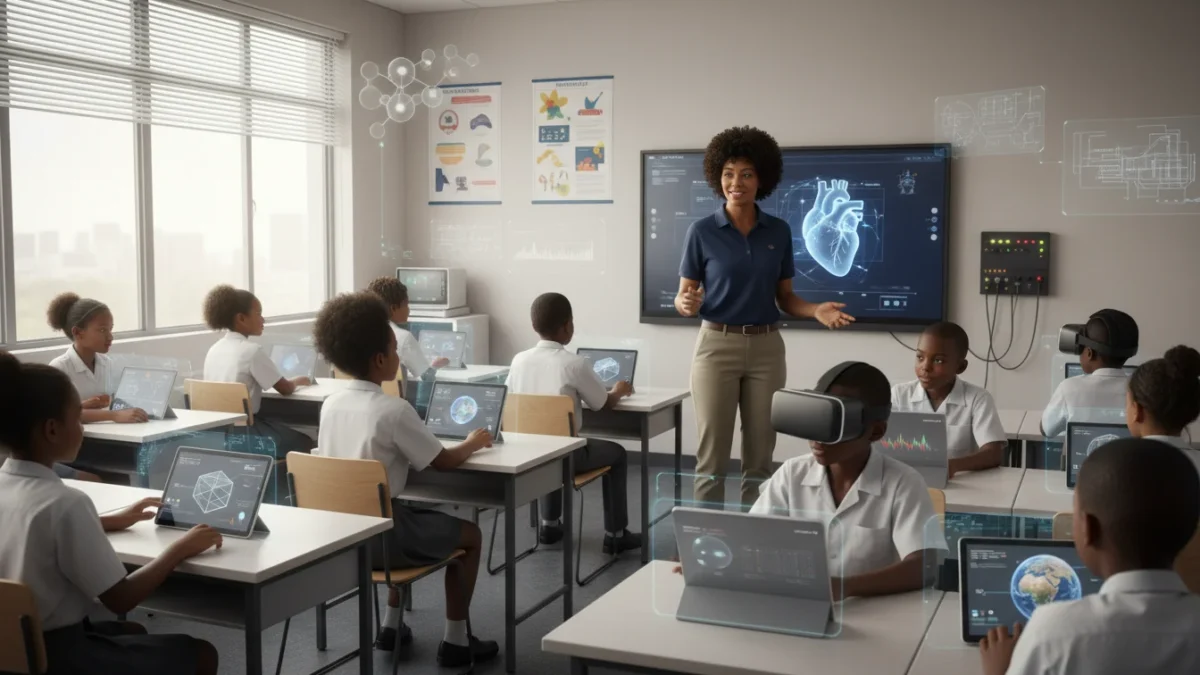
Cape Town – A recent review study has highlighted the need for adequate strategies, investment and teacher development to support Augmented Reality and Virtual Reality in South African Basic Education.
“Unequal access between rural and urban school, teacher preparedness, insufficient policy integration and limited institutional support continue to constrain large-scale implementation,” the author of the study, Beauty Mugoniwa, said.
According to the study, published in the Journal of Information Systems and Informatics, the integration of AR/VR into South Africa’s basic education system could help improve learner engagement, experiential learning and conceptual understanding.
However, there are several limitations highlighted by the study, including AR/VR usage being
concentrated in STEM subjects and in better-resourced urban schools.
Therefore, the author argues that better investment is needed to support the implementation of AR/VR in education, including infrastructure, curriculum policy and teacher development.
According to a 2023 research article published in Social Sciences & Humanities Open, AR/VR usage in education has seen an increase in opportunities to enhance learning.
“Augmented Reality (AR) is a technology that enhances the real-world environment around us by overlaying computer-generated content onto it,” the 2023 research said.
“VR enables users to immerse themselves in vividly realistic simulations of real or imaginary worlds.”
Within the context of education, Mugoniwa suggests that AR and VR can “enhance spatial understanding, immersive simulations and student participation across various subjects.”
This would drive the importance of ensuring education teaches students how to navigate these technologies and environments, according to Mugoniwa.
“This is however determined by teaching and learning activities involved, student acceptance, teacher preparation and reliable infrastructure.”
Mugoniwa also reiterates the need for further research into the use of the technologies in the classroom.
“Stronger empirical and longitudinal research is still needed to evaluate sustainable
classroom implementation and broader educational impact across diverse South African
school context,” says Mugoniwa..
Beauty Mugoniwa is from the Department of Information Systems, College of Science, Engineering and Technology, University of South Africa, South Africa.
References:
Al-Ansi, A. M., Jaboob, M., Garad, A., & Al-Ansi, A. (2023). Analyzing augmented reality (AR) and virtual reality (VR) recent development in education. Social Sciences & Humanities Open, 8(1), 100532.
Mugoniwa, B. (2026). Embracing Augmented Reality and Virtual Reality in South African Basic Education: A Systematic Literature Review. Journal of Information Systems and Informatics, 8(3), 3487-3515.